Description
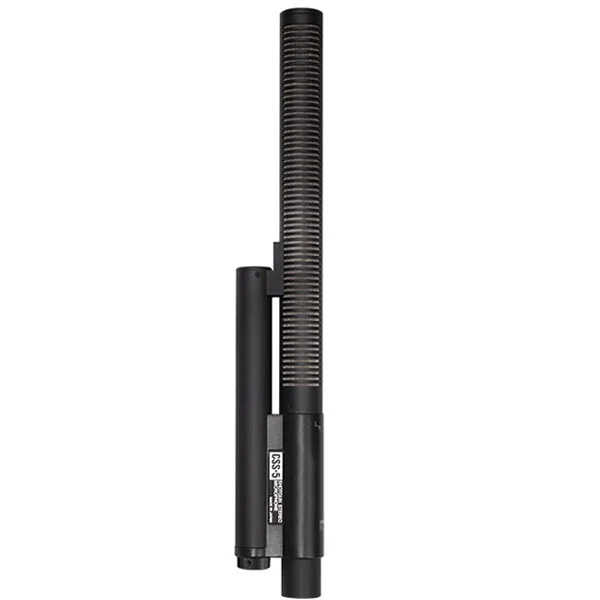
The ultimate stereoscopic shotgun microphone with 5 capsules and 3 modesMono/Stereo/Wide
With three modes (mono, stereo, and wide) suited to a wide range of recording applications in the studio and in the field. The mono mode provides high directivity across a wide frequency spectrum, especially below 500Hz. Excellent for noisy environments. Low proximity effect.
The CSS-5’s remarkable performance is based on a set of five new directional condenser elements, featuring new PPS (polyphenylene sulfide) diaphragms for optimal humidity and temperature stability. Developed in collaboration with NHK, the CSS-5 is also responsive in both the horizontal and vertical planes, with high sensitivity, a wide frequency response, and excellent dynamic range.
The CSS-5 is presented with an optional GS-5e hanging handle
Highlights of the Sanken CSS-5 microphone
Supercardioid shotgun switch microphone
Unique design with 5 capsules
Superb 180-degree rear rejection, even in the low frequencies
MONO-STEREO compatibility; Mono and phantom center have the same sound characteristics
Wide frequency response 100Hz-15kHz
Monofor clear directivity and excellent low-frequency definition
Normalfor precise directional hypercardioid focusing with accurate stereo localization
LargeStereo image widened to 140 degrees for cinematic rendering and stereo sound effects
Uses standard accessories
Dual 48-volt phantom power required
Standard XLR5 connector
Record targeted sounds using the additional option of capturing realistic stereophonic perspectives
For television, film/video documentaries, and large broadcast events, accurately recording sound has become desirable, with the added option of capturing realistic stereophonic perspectives. In many cases, multiple microphone setups hinder mobility in the field and compromise sound consistency.
Stereophonic localization depends primarily on signal accuracy and channel separation within the 400 Hz to 3 kHz range. The CSS-5’s model control has been optimized within this range. The very low and very high frequency response has been optimized along the front axis so that the « target » sounds on the axis are clearly defined. The resulting playback emphasizes the front image, with side signals positioned slightly further back.
In MONO mode, directivity is maintained across a wide frequency range for targeted front sound sources by combining a second dimmable microphone and a line-level microphone. Significantly, the CSS-5 captures the chosen sound source very clearly, even in noisy environments or long reverberation spaces.
In NORMAL mode, the CSS-5 clearly captures the targeted sound and provides extremely precise stereo localization. The STEREO angle is approximately 115°
The WIDE mode is designed for stereo recording of sound effects and environmental information in which the dialogue will be dubbed at a later date. This mode allows for a wider stereo image of 140 degrees.
In stereo recordings, the frequency response of the summed MONO output often exhibits interference, or « comb filtering. » This phenomenon is due to phase differences between the left and right signals. This does not occur during spot, XY, or MS recordings, but it does occur during stereo recordings spaced one mic-AB apart due to the time intervals between the two capsules. In the CSS-5, the three-capsule line array is designed for front-end pickup, with its elements arranged vertically along the same axis. Therefore, mono/stereo compatibility is adequate.